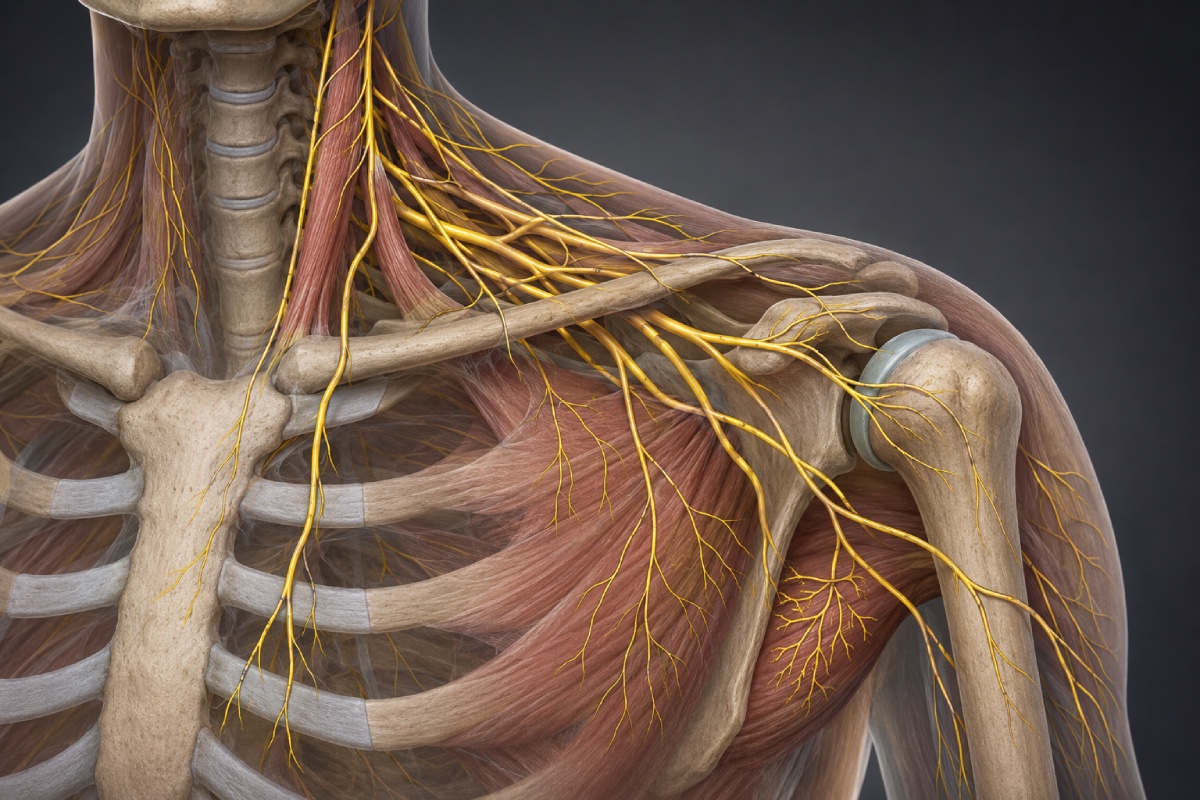
Shoulder surgery is frequently associated with substantial postoperative pain, making regional anesthesia an important component of perioperative analgesia. For decades, the interscalene brachial plexus block has been considered the gold standard for shoulder analgesia because it reliably anesthetizes the C5–C7 nerve roots that contribute to shoulder innervation. However, a major limitation of the interscalene approach is its close anatomical relationship to the phrenic nerve, which is responsible for diaphragm control.
Hemidiaphragmatic paresis occurs in a high proportion of patients receiving traditional interscalene blocks, often approaching 100% with conventional local anesthetic volumes, which may be clinically significant in patients with limited pulmonary reserve (1). However, phrenic nerve sparing strategies in regional anesthesia for shoulder surgery may be used to reduce the risk of impairing respiration.
The importance of phrenic nerve blockade lies in its effect on the diaphragm, the primary muscle of respiration. The phrenic nerve provides motor innervation to each hemidiaphragm; therefore, inadvertent blockade during an interscalene block can result in temporary weakness in or paralysis of one side of the diaphragm. Although this is usually well tolerated in healthy individuals, it may reduce pulmonary function and cause dyspnea or increased work of breathing in patients with chronic lung disease, obesity, advanced age, or other respiratory comorbidities (2). Consequently, considerable effort has been directed toward developing regional anesthesia techniques that preserve diaphragmatic function while maintaining effective analgesia (1).
One strategy for sparing the phrenic nerve from nerve block is to lower the volume of local anesthetic used during ultrasound-guided interscalene block. Smaller volumes with accurate needle placement may limit spread to the phrenic nerve while preserving analgesic efficacy. Nevertheless, because of the close proximity of the phrenic nerve to the brachial plexus roots and anatomical variability across patients, even low-volume interscalene techniques cannot reliably eliminate hemidiaphragmatic paresis (1). As a result, alternative approaches have been developed to provide shoulder analgesia with a lower risk of respiratory impairment.
The superior trunk block has emerged as one of the most promising phrenic nerve–sparing techniques for providing analgesia during shoulder surgery. By targeting the superior trunk distal to the convergence of the C5 and C6 roots, the injection is performed farther from the phrenic nerve than in a traditional interscalene block. Randomized controlled trials have demonstrated that superior trunk block provides analgesia comparable to interscalene block for shoulder surgery while significantly reducing the incidence of hemidiaphragmatic paralysis (3). These findings have made superior trunk block an attractive option for patients in whom preservation of respiratory function is a priority.
Another diaphragm-sparing approach involves selective blockade of the suprascapular and axillary nerves, which together provide much of the sensory innervation to the shoulder joint. Because these blocks are performed at locations distant from the cervical nerve roots, the likelihood of phrenic nerve involvement is substantially reduced. Although analgesia may not be as dense as that achieved with interscalene block for some procedures, this technique offers a favorable balance between pain control and respiratory safety, particularly in high-risk patients (1).
Although interscalene block remains a highly effective analgesic technique for shoulder surgery, concerns regarding phrenic nerve blockade have driven the development of diaphragm-sparing alternatives. Superior trunk block and selective peripheral nerve blocks offer a means of reducing respiratory compromise while maintaining satisfactory analgesia, particularly in patients at increased pulmonary risk.
References
1. Tran DQ, Elgueta MF, Aliste J, Finlayson RJ. Diaphragm-Sparing Nerve Blocks for Shoulder Surgery. Reg Anesth Pain Med. 2017;42(1):32-38. doi:10.1097/AAP.0000000000000529
2. Robles C, Berardone N, Orebaugh S. Effect of superior trunk block on diaphragm function and respiratory parameters after shoulder surgery. Reg Anesth Pain Med. 2022;47(3):167-170. doi:10.1136/rapm-2021-102962
3. Kim DH, Lin Y, Beathe JC, et al. Superior Trunk Block: A Phrenic-sparing Alternative to the Interscalene Block: A Randomized Controlled Trial. Anesthesiology. 2019;131(3):521-533. doi:10.1097/ALN.0000000000002841